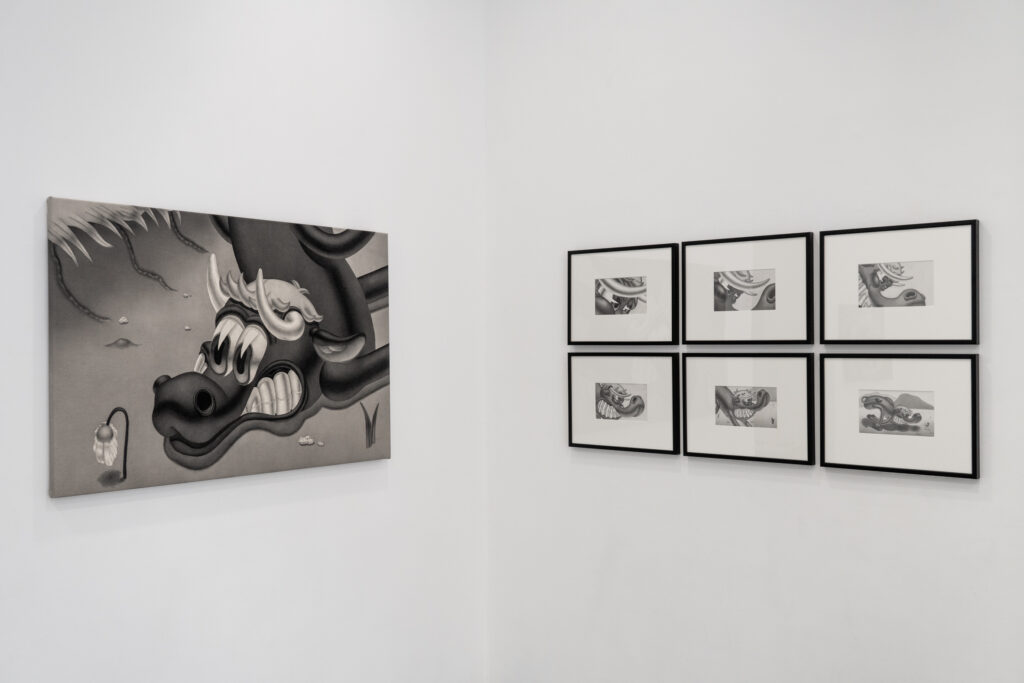
Exhibition dates: November 27th – January 30th 2025 (closed from December 23rd to January 7th)
SC Gallery presents Abanto (Timid bull), a solo exhibition by Fernando Tinoco (Medina de las Torres, Badajoz, 1999), from 27 November 2025 to 30 January 2026, in Bilbao.
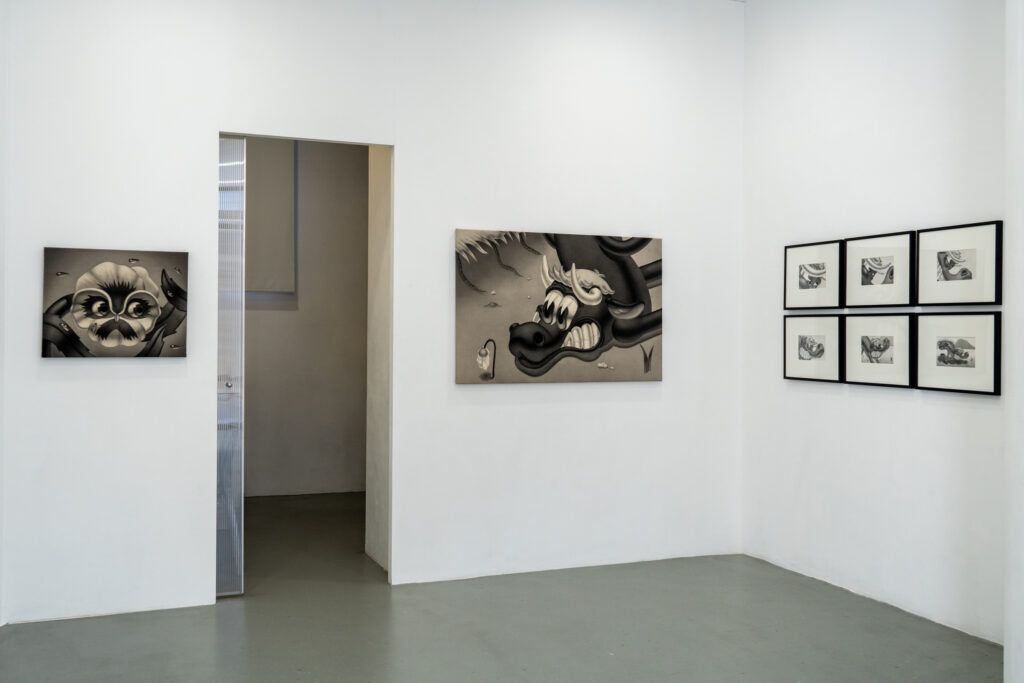
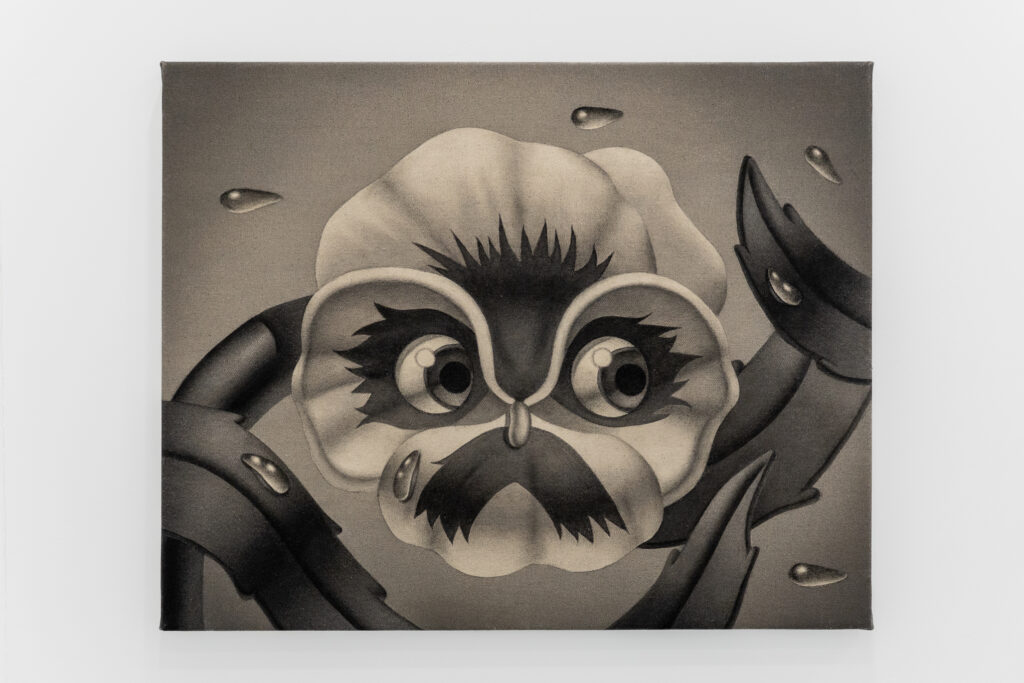
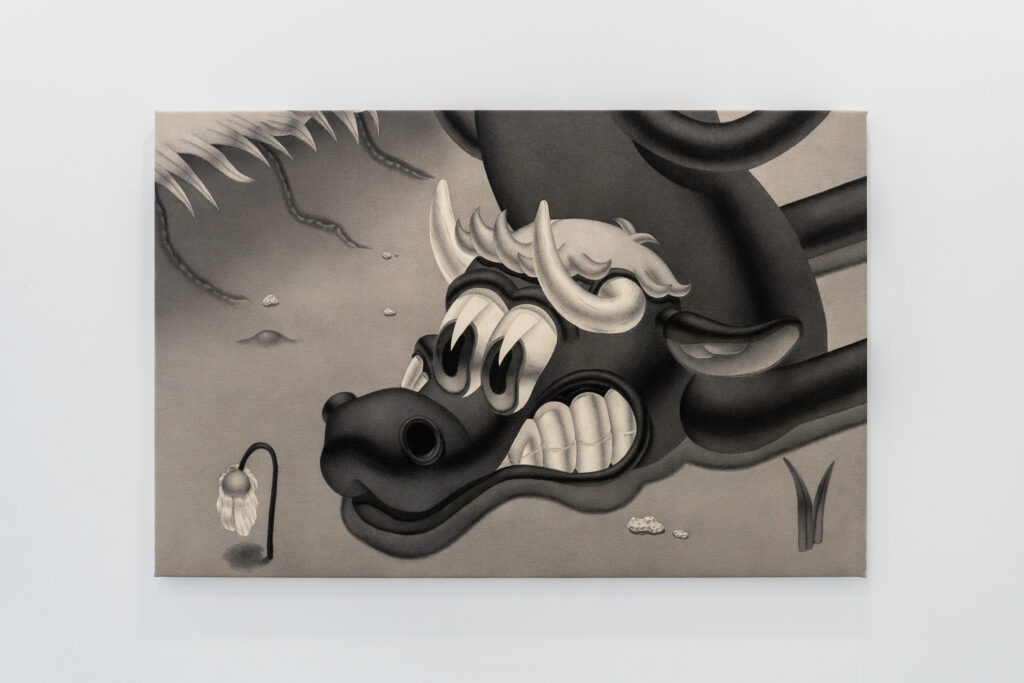
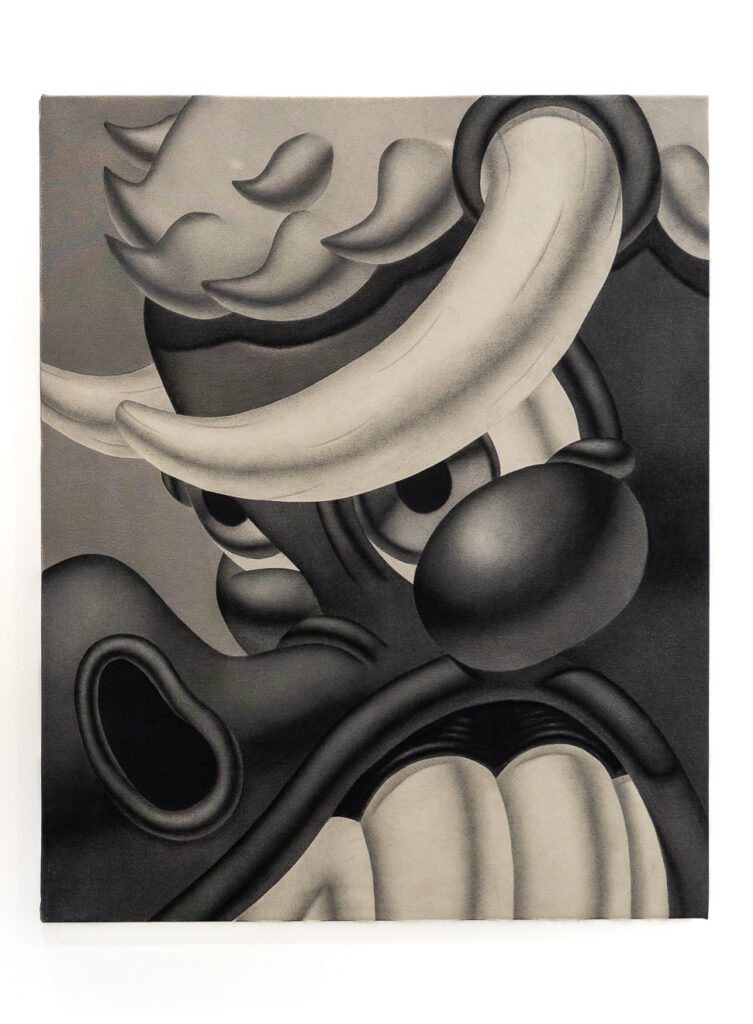
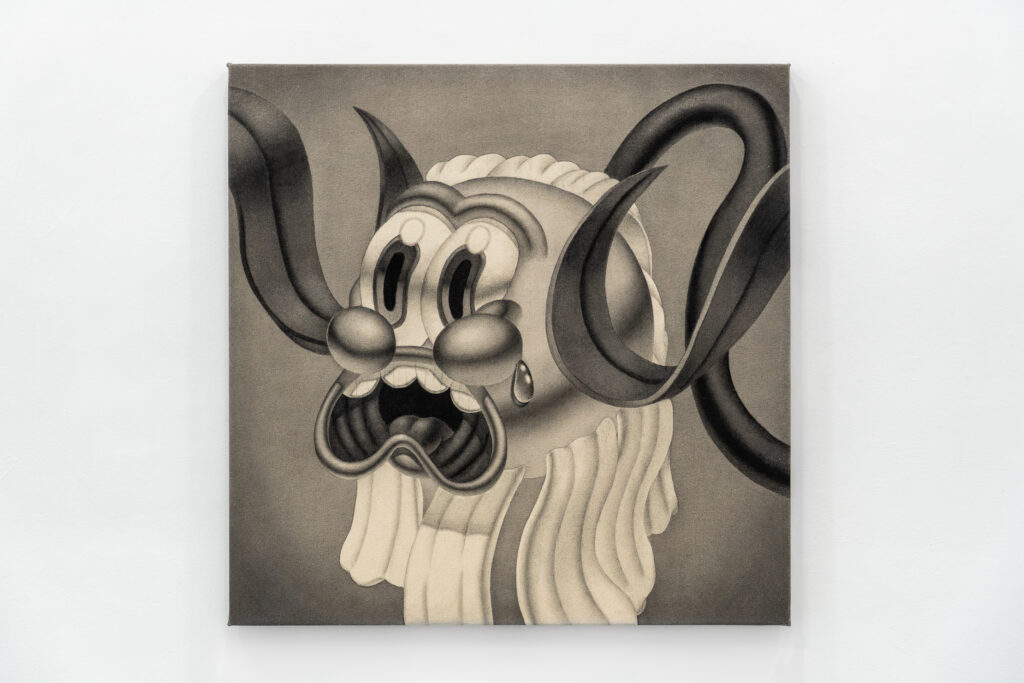
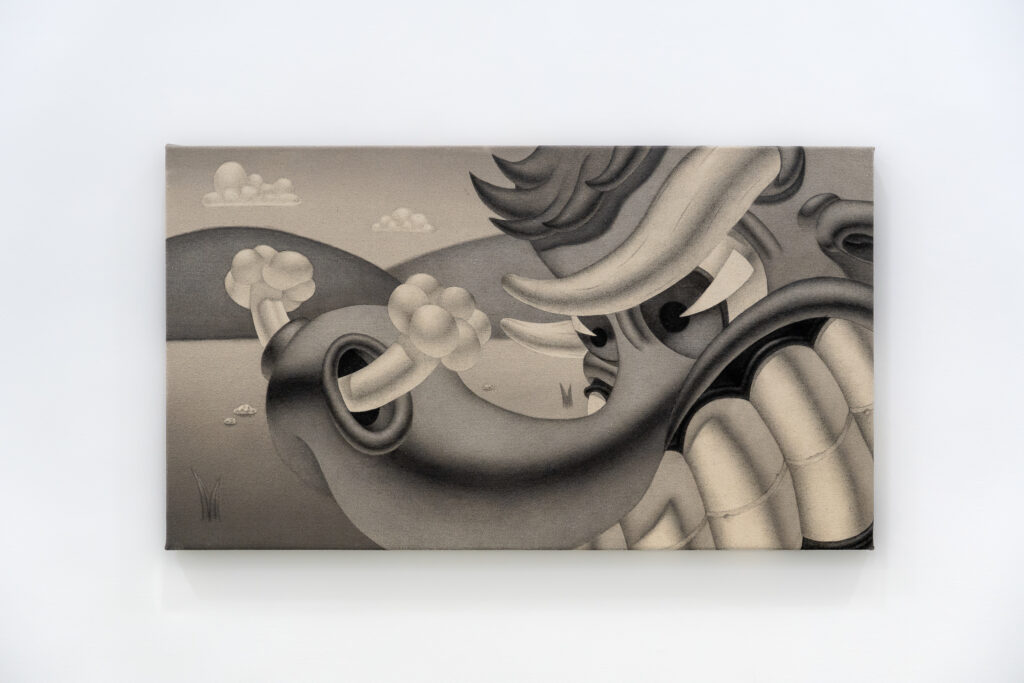
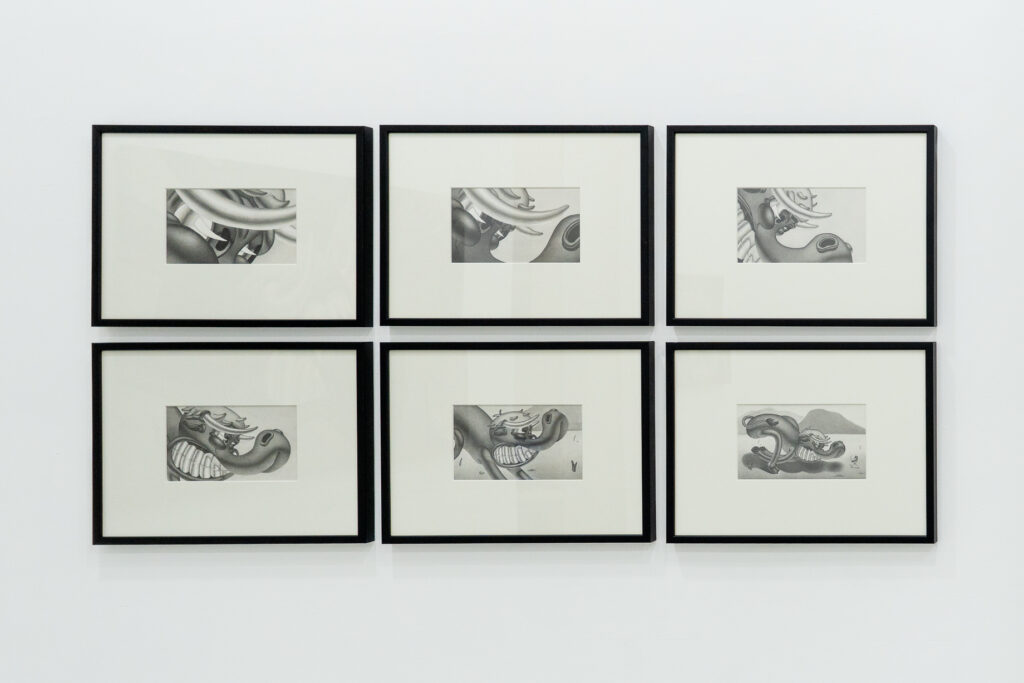
Abanto (Timid bull) is Fernando Tinoco’s first solo exhibition at SC Gallery, consolidating a collaboration that opens up new avenues of artistic exploration. The exhibition offers an immersion into a hybrid, mythological, and dreamlike universe, where contemporary tensions between sensitivity and violence are revealed through two-faced creatures and compositions that evoke the ancestral and the molecular. Tinoco constructs a worldview that connects the visible with the invisible, the spiritual with the biological.
His practice revolves around drawing on paper and canvas —graphite, charcoal, and conté— and is part of a genealogy of artists who champion the raw and the emotional as a visual language, in tune with international figures such as Raymond Pettibon and Chloe Piene. Tinoco’s imagery, populated by distorted beings and fragmented narratives, reflects a generation marked by emotional overexposure, black humor, and the aesthetics of the absurd.
The exhibition will be on view at SC Gallery in Bilbao and will be accompanied by a curatorial text by Almudena Blasco.
Tinoco’s art, understood as a robust anticipation of a new natural order of living beings, is truly happening. Averroes and his followers, in Cordoba under Almohad rule, would speak of the effect of melancholy on the soul of an artist who seeks harmony between opposites amid phantasmagorias. The image created is uncomfortable because it recalls the persistence of opposing binomials as remnants of an ontology of struggle, of war. Actually, if we think about it, everything is one: beauty and beast, lightness and weight, sensitivity and brusqueness, where the option of grays is a commitment to place oneself between black and white.
If the analysis continued along these lines and resorted to comparisons of his work with that of Max Ernst, we would begin to hear the creaking of our convictions as they cracked. We are stopped at an intersection and the traffic light is green. Because facing the whole in a world of diversity requires grasping the fact that truth is contained in contrasting features. And that generates a tension that art deduces from the celestial spheres, of mythical origin; and this is so because art has been, and is, a reading of the sublime from the everyday.
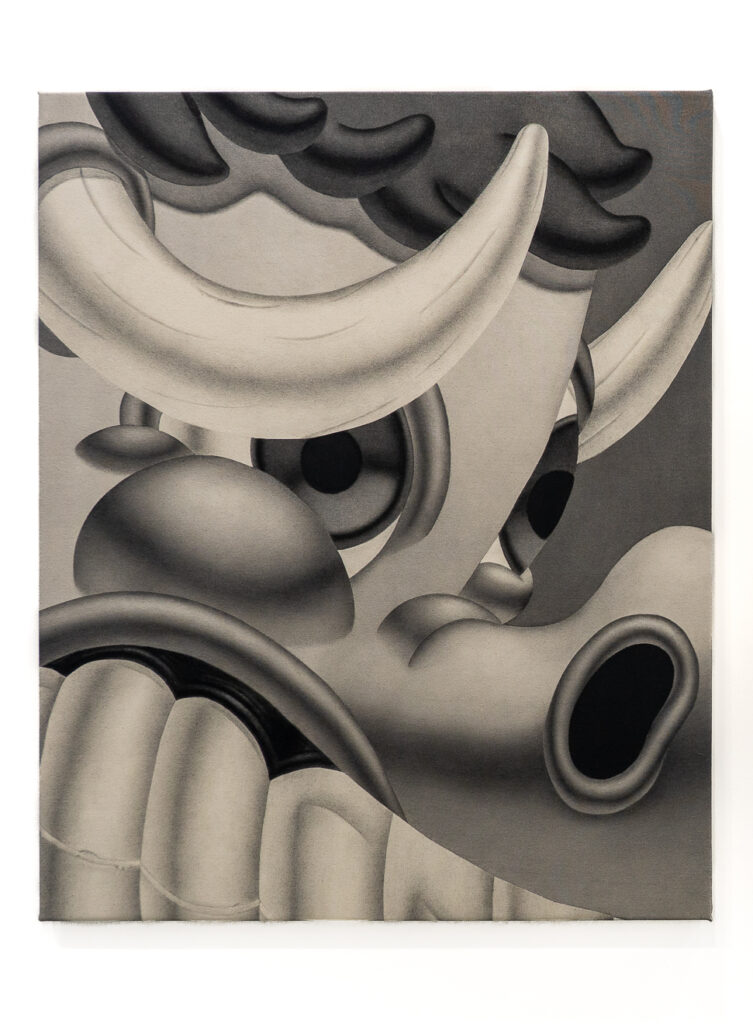
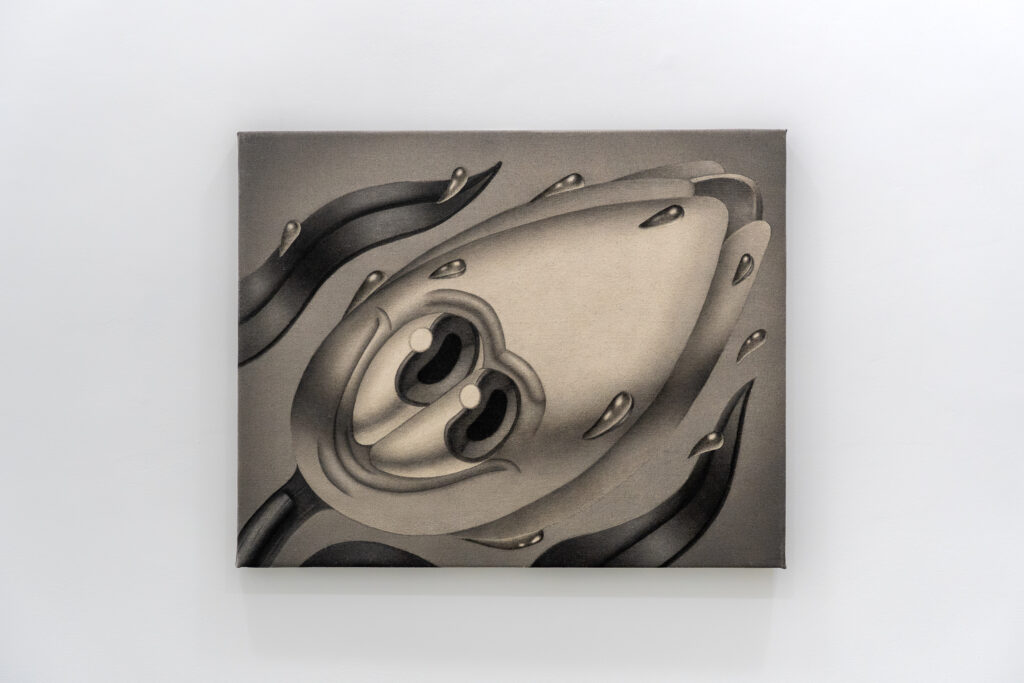
Tinoco’s art stems from depth psychology with creatures born of the Mediterranean imagination at the beginning of time (in Egypt with Apis, in Crete with the Minotaur) and reaching the romantic soul with Arnold Böcklin’s centaurs and the surrealist soul with René Magritte’s bowler-hatted men. There is a warning before resignation, and it is shown as a human face metamorphosed into a frog. Uniting the dissimilar is the goal of this art that is truly happening: a sensitive act activated by a sudden gesture against what is perceived, an inner fire that warms a lethargic society. In this way, it relentlessly brings sensitivity and abruptness together to define an enigma, and it does so with the same necessity with which the ancients turned to the oracle: to explain a step devoid of movement, because it is a single substance. The creative effort does not end there; it goes further, with a phylogenetic vigilance embodied in two-faced but uniform figures that respond to the same principle by which proteins are assembled, as molecular genetics teaches us: a process of grouping the elements that form membranes.
Tinoco’s art responds to an advanced state of consciousness with hybrid creatures as avatars of a current concern consisting of the titanic struggle against what is genetically imposed on us: like that bull in love with flowers, but who is trained to be what his genes have prepared him to be, not his sensitivity to beauty, but his brusqueness expressed in his charge as a metaphor for the situation of a world on the border between the real and the imagined. And there the grays emerge as a form of radical expression. The formidable pathognomonic resource that characterizes this exhibition is a way of recovering the present moment with art that is truly happening as a support for an original narrative about the reality of a world that unfolds in diverse pieces to obtain a totally renewed overview of the great arguments that define the evolution of the species.
Almudena Blasco Vallés
Abanto (Timid bull) (This art is really happening)
ABOUT FERNANDO TINOCO:
Fernando Tinoco (Badajoz, 1999). Graduate in Fine Arts from the University of Granada.
Fernando Tinoco’s drawing runs through his life in a transversal way, traversing his earliest memories and experiences, which end up tied together and synthesized through an outlook that he shares with his generation. His pieces are long-exposure photographs in which, over the years, the protagonists have been unable to hide their uncomfortable expressions. His love of animation is something he has retained since childhood, and it is evident in the iconography he uses to converse with the rest of the world.
His work doesn’t attempt to address issues outside his context. The fence he walks along has no more hectares than the village where he lives, and the smaller the fence, the better. His connection to the Extremaduran countryside and its inhabitants inspires him to depict characters from classic fables, fables in which the moral is never clear-cut. However, this territorial isolation does not shield him from the pessimism that colors his entire generation with such a gray tone. For this reason, irony is subtly evident in his drawings, avoiding the saccharine and generating a certain feeling of guilt in those who dare to smile when looking at one of his pieces.
On a technical level, he aims to develop that almost automatic skill, typical of master craftspeople, which invites him to enter that meditative state that the artist so pursues. He feels that the bond with his work must be justified by the affection he devotes to each of his pieces, and in this, time is a crucial factor.
For further information, please contact:
Press / Email: comunicacion@scgallery.es
