
Exhibition dates: 13 February – 10 April 2026.
El cuerpo sostenido (The sustained body)
Solo exhibition by Nieves González
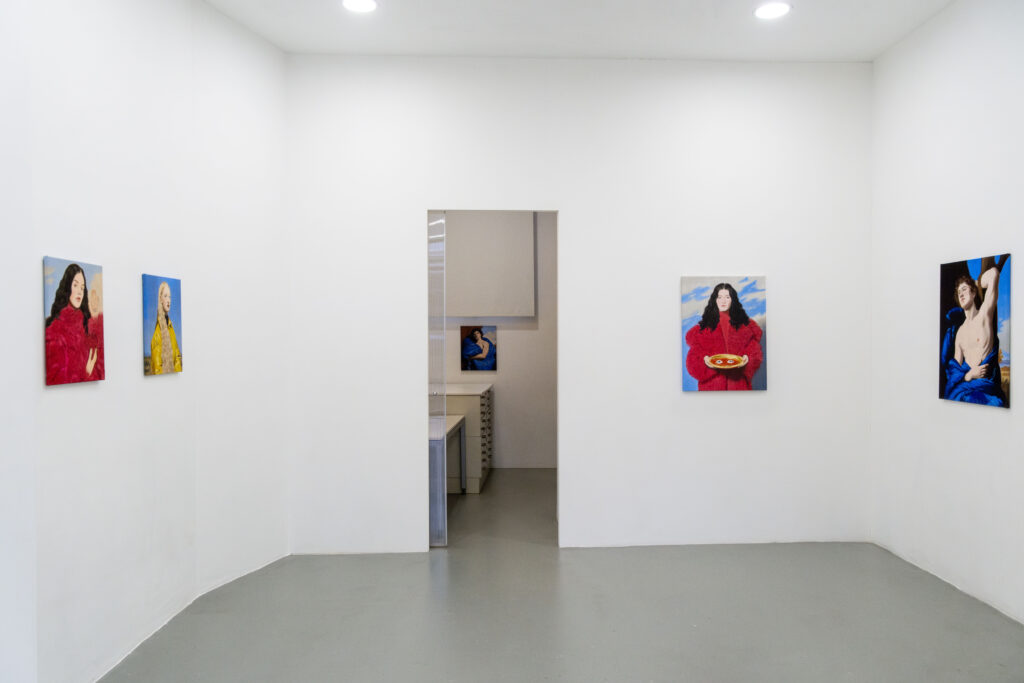
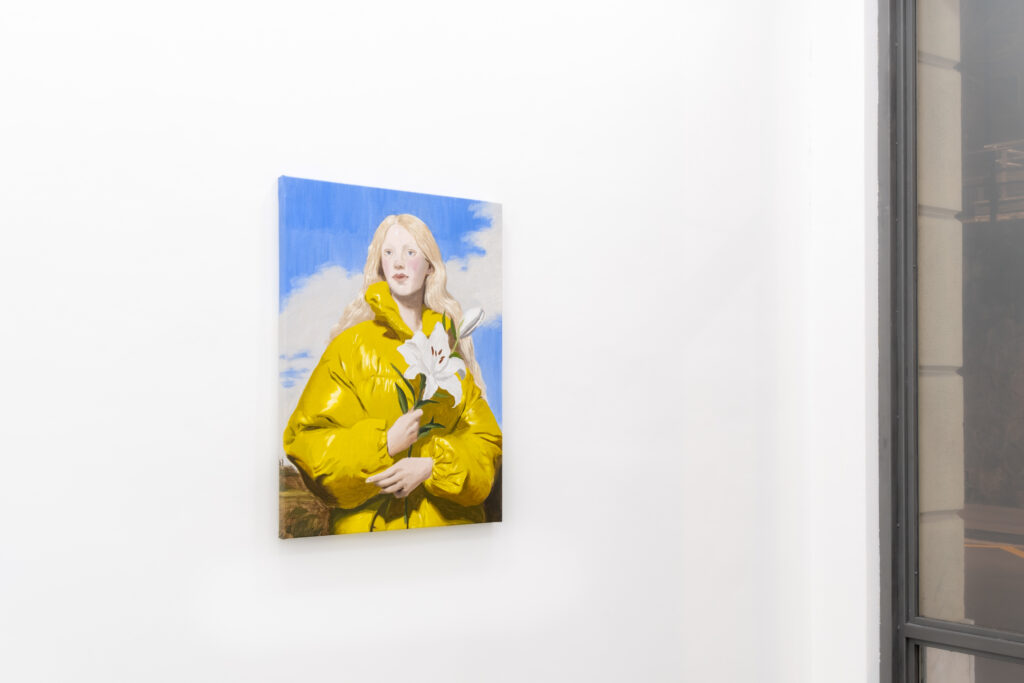
SC Gallery presents “El cuerpo sostenido” (The sustained body), the first solo exhibition in Bilbao by artist Nieves González (Huelva, 1996). The exhibition stems from an encounter González had years ago with José de Ribera’s painting Saint Sebastian Tended by the Holy Women (c. 1620-1623) at the Bilbao Fine Arts Museum during the year she was studying in the city. That initial visual impact has matured into the conceptual core of the project: a reinterpretation of care as a sacred act and of the feminine as a space for healing.
The project is accompanied by a curatorial text by Las Hijas de Felipe (Felipe’s Daughters) —Carmen Urbita and Ana Garriga—, whose research on Spanish Baroque and its resonance in today’s culture has generated a unique interpretation framework. This text links González’s painting to a genealogy of narratives in which the past does not operate as an immobile archive, but rather as a living territory from which to interrogate the present.

“Everyone goes to the square. They watch the knight of Jesus Christ being led away between executioners and guards, with town criers walking before him. It was a profoundly pitiful sight to see such a striking man, of fine bearing, endowed with such virtues, lineage, condition, and customs, die such a death.” With these words from 1589, the hagiographer Alonso de Villegas described an inescapable and iconic scene from the Catholic book of saints’ lives: Sebastian, renowned captain of Emperor Diocletian (c. 244–c. 311), has fallen from grace after revealing his true faith, and now, harassed by the crowd, is escorted to the place of his martyrdom. “They arrive at the stake. Sebastian embraces it. He speaks sweet and kind words to Jesus Christ… Thus speaks the brave knight now stripped naked: they bind him to the wood; they blindfold him; the crowd withdraws; they begin to shoot arrows at him.” In the naked and vulnerable “striking man” that Villegas describes, we can discern traces of that charmingly languid saint, graced with a beauty untouched by pain, which emerges in Counter-Reformation iconography as an irresistible homoerotic ideal. Yet, in the “brave knight” of the hagiographer’s account, despite everything, remains the almost warlike fortitude of a saint who, as early as the third century, was commended by Pope Caius as Defensor Ecclesiae: a soldier capable of shielding the body of the Church from the dual threat of heresy and disease.
When recurrent outbreaks of the plague besieged Europe in the sixteenth and seventeenth centuries, the pictorial representations of Saint Sebastian became both a refuge and a charm in the midst of widespread dread. For those seeking consolation, the arrows that pierced the saint became a symbol of the capricious randomness with which the disease launched its own darts, while the wounds each arrow caused appeared, in their eyes, to exude the very stench of the dreaded plague buboes. Saint Sebastian, bound to a tree or a pillar and pierced by arrows, was, consequently, an omnipresent and pedagogical presence, teaching how to confront pain and illness with the same resignation as Christ on the cross. Nonetheless, the legend of Saint Sebastian contains another episode—less frequently addressed yet not entirely absent from seventeenth-century painting—, a scene that Villegas scarcely tiptoes around: “In a short time they shot so many [arrows] at him that they left him for dead, although in truth he was not. Later that night, a holy matron named Irene came to bury his body and found him alive. She took him down from the stake, carried him to her house, and tended to him with great care until he was fully healed.” This is the moment that captivated José de Ribera in his Saint Sebastian Tended by the Holy Women (c. 1620–1623) and that, across the centuries, continues to captivate Nieves González. This secondary episode, overshadowed by the flamboyant scene of martyrdom, offers—at the peak of medical science innovation—not only a promise of healing as an alternative to the narrative of sacrifice, but also suggests the central role of two women in this therapeutic labor at a time when women such as María Sánchez de la Rosa (c. 1642–1717) or Elena de Tordesillas (b. c. 1659) were prosecuted by the Toledo Tribunal of the Spanish Inquisition on charges of witchcraft for practicing medicine.
Nieves González’s painting occupies, with the poised balance of a tightrope act, a transhistorical bridge that invites us to detach from the present by looking at it through the lens of the past. As we consider her reinterpretation of Ribera’s painting, we—always bustling and willing to traverse that bridge back and forth—surrender ourselves to imagining a time when the canvas was viewed beyond the sterile confines of a modern museum. Following the death of Philip IV in September 1665, Queen Regent Mariana of Austria took charge of overseeing the ornamentation of the Vicars’ Chapter at El Escorial, one of the two halls in which the monastery’s Hieronymite monks gathered. Although we know that, before his death, Philip IV had initiated the process of acquiring the twenty-two works that would embellish the walls of the chapter, we cannot help but imagine a Mariana de Austria who, with stubborn resolve, sought to feminize that masculine space of authority through the figure of a saint who, in a state of vulnerability, is tended with surgical precision and tender care by Saint Irene and her companion. It is precisely this collaborative engineering of care that, in 1667, elicited the admiration and astonishment of the Hieronymite Francisco Santos (1617–1699), when he described Ribera’s painting in his Descripción del Real Monasterio de San Lorenzo del Escorial: “The holy matron—her face beautiful and filled with compassion—holds a vessel in her left hand and, with her right hand, with remarkable grace and precision, takes up the balm or ointment to anoint and heal him. Another woman leans in to remove the arrows, with such care and tact, to shield him from pain, that all who look upon her are moved to that same care; nothing could be painted more vividly.” As the Hieronymite monk once did, we now move slowly across the figures in Nieves González’s canvas, delighted to discover in the enduring “remarkable grace and precision” of the “holy women” a feminized genealogy of knowledge.
Las Hijas de Felipe
Carmen Urbita y Ana Garriga
ABOUT NIEVES GONZÁLEZ
Nieves González (Huelva, 1996) constructs a visual territory where pictorial memory and contemporary urgency converge. Her practice is not limited to citing the past; she subjects it to a poetic dissection that reveals new anatomies of the present. Although they are structured around the pictorial tradition, her compositions critically question that legacy, establishing a productive tension between what is inherited and what is possible. In her canvases, classical canons undergo a deliberate metamorphosis that transforms the familiar into something disturbing and new, allowing her work to be simultaneously recognizable and challenging.
Each work acts as a link in a broader conceptual chain, where the Western pictorial heritage is not contemplated as a museum but as living matter liable to transformation. Her pieces construct a generational conversation about tradition, questioning what it means to inherit a visual language in a world that has reconfigured its codes of perception. Her work lies at the meeting point between the sacred and the profane, a space where dualities are questioned and the ambiguity inherent in all human experience is revealed.
Nieves González graduated in Fine Arts from the University of Seville, where she also obtained a Master’s degree in Art: Idea and Production. Her recent projects include her participation in Untitled Miami with Richard Heller (Miami), the solo show “Sacred Hair/Capelli Sacri” at T293 (Rome), and her presence at Art Shanghai with HDM Gallery.
Artist: Nieves González (Huelva, 1996).
Exhibition dates: 13 February – 10 April 2026.
Venue: SC Gallery (Bilbao)
Address: Calle Cortes 4. Bilbao.
Opening times: Tue – Fri: 17:00 – 20:00 h. Saturdays and mornings: 11:00 – 14:00 (appointment needed)
For further information, please contact:
Press / Email: comunicacion@scgallery.es
